
A Lesser Library
On labyrinths, burning libraries, and how to replenish an empty shelf.

At the end of The Name of the Rose, the library burns.
This summer, I returned to that book for the first time in about 20 years, reading it in Istanbul, a city I have loved and left before, a few days before flying back to Los Angeles to begin rebuilding my own library. The library a fire had already taken.
I don’t think the timing meant anything. It wasn’t something I consciously chose. I also haven’t been able to stop thinking about the coincidence.
The one book
On the evening of January 7, 2025, the Eaton Fire came down out of the mountains and into Altadena. The fire spread out through the neighborhood, burning about half the homes in Altadena. The afternoon of January 8, with the fire still moving through the neighborhood, Zeliha and I went back to the house to, first, see if it had burned. Somehow, it and our immediate neighbors were still standing. Two doors up from our own, we watched our neighbor’s home burn to the ground. And across the cross street fifty yards south of us, we watched another neighbor’s home burn. Two doors in any direction from our own, everything was either burned or burning. The air was all smoke. Power lines littered the streets. Fires were everywhere. Everything was destruction or being destroyed. Our home was somehow there, and our stuff was still inside, and we didn’t know if this was the last time we’d see any of it.
We entered the house. The moment was frantic: homes burning down around us, unsure if we could get back out of the neighborhood safely, no protective gear, just knowing we needed to grab the most important things, valuables, papers, passports. And as we left, I grabbed one book.
Out of a house full of thousands of books, I carried out a single volume: my first-edition Italian copy of Il nome della rosa. The Name of the Rose. My college graduation gift from my dad.
I didn’t choose it the way you choose something. I didn’t stand there weighing the collection against itself. We were standing in a smoke-filled house without protective gear a few yards from an active fire. There wasn’t time, in that moment, to think about the story inside the book. That came a year and a half later in Istanbul, realizing that the book I carried out of the fire is a book that ends with a library burning to the ground.
The labor of the labyrinth
The library in The Name of the Rose is a labyrinth: a locked maze of rooms in a tower called the Aedificum, arranged so that only the librarian can find his way to the center. The forbidden knowledge at the center is guarded by disorientation. You don’t read your way to the forbidden book. You get lost on the way to it, finding it only after your logic and learning allow you to accidentally stumble upon it. Getting lost until you realize your knowledge is simultaneously necessary and irrelevant is the point.
I’ve been obsessed with labyrinths for a long time, starting with Eco and Borges and Kafka in high school, through my undergrad comp lit honors thesis surveying the labyrinth in literature, and into my own book, A Turkish Dictionary, where the idea of the labyrinth surfaces in endless arabesques and endless histories and endless connections. A labyrinth is a structure built specifically so that you can lose yourself inside it and, if you’re patient and a little lucky, find your way back out changed. Borges knew this: his “Library of Babel” is the labyrinth pushed to infinity, a library containing every possible book, and so a place where you can never really find meaning. Eco’s library is different. Borges gives you the infinite library as an idea. Eco makes you smell the glue.
(As I write this, I think of how The Name of the Rose is, in a way, Eco’s merging of Borges’ three largely separate modes of story into one novel: the idea story of “Library of Babel” or “Tlon, Uqbar, Orbis Tertius”; the detective story of “The Garden of Forking Paths”; and the stories of Argentina, the pampas, and gauchos of “The South” or “The End of the Duel”.)
The Name of the Rose is really a book about the labor of books and knowledge. It’s about the monks who copy, page by page, the books that will outlive them. It’s about the illuminators who work in the margins—and the whole novel is, in a way, an argument that history happens in the margins, among the people who carry knowledge forward without ever being named by it. The two men at the center of the mystery are lost to history. So is functionally everyone in the book, including the site of the library and abbey. Their story survives in an accidental copy that may or may not be genuine. And still it becomes more real to us than the official history of the “great men” whose machinations set everything in motion. The devil is in the details, the book keeps insisting, and it means the phrase literally: this is where the impact of power actually lands, down here, in the margins, on the “simple” people, to use William’s own phrasing, who are, in one of the book’s coldest lines, “meat for slaughter.” I don’t know if William explicitly understands at the end that he is, in fact, one of the “simple” that he otherwise has differentiated himself from throughout the book. But I do think he implicitly understands, as does Adso.
And because this library is real, because the books are pulp and glue and binding, because in the story we are pre-Gutenberg, when something is lost, it is lost forever. The book Jorge de Burgos is willing to burn everything to ensure nobody reads is the lost second book of Aristotle’s Poetics. First, its pages are poisoned, then chewed, and then, in the fire, gone.
In no time, the place was a brazier, a burning bush. The bookcases themselves also joined in this sacrifice and were beginning to crackle. I realized the whole labyrinth was nothing but an immense sacrificial pyre, all prepared for the first spark.
I re-read the book for the first time in 20 years in the city where, once, I had built a home and lost it. I’ve since built a home again and, now, lost it again. A home where fire had made the same argument to me in a language I couldn’t refuse.
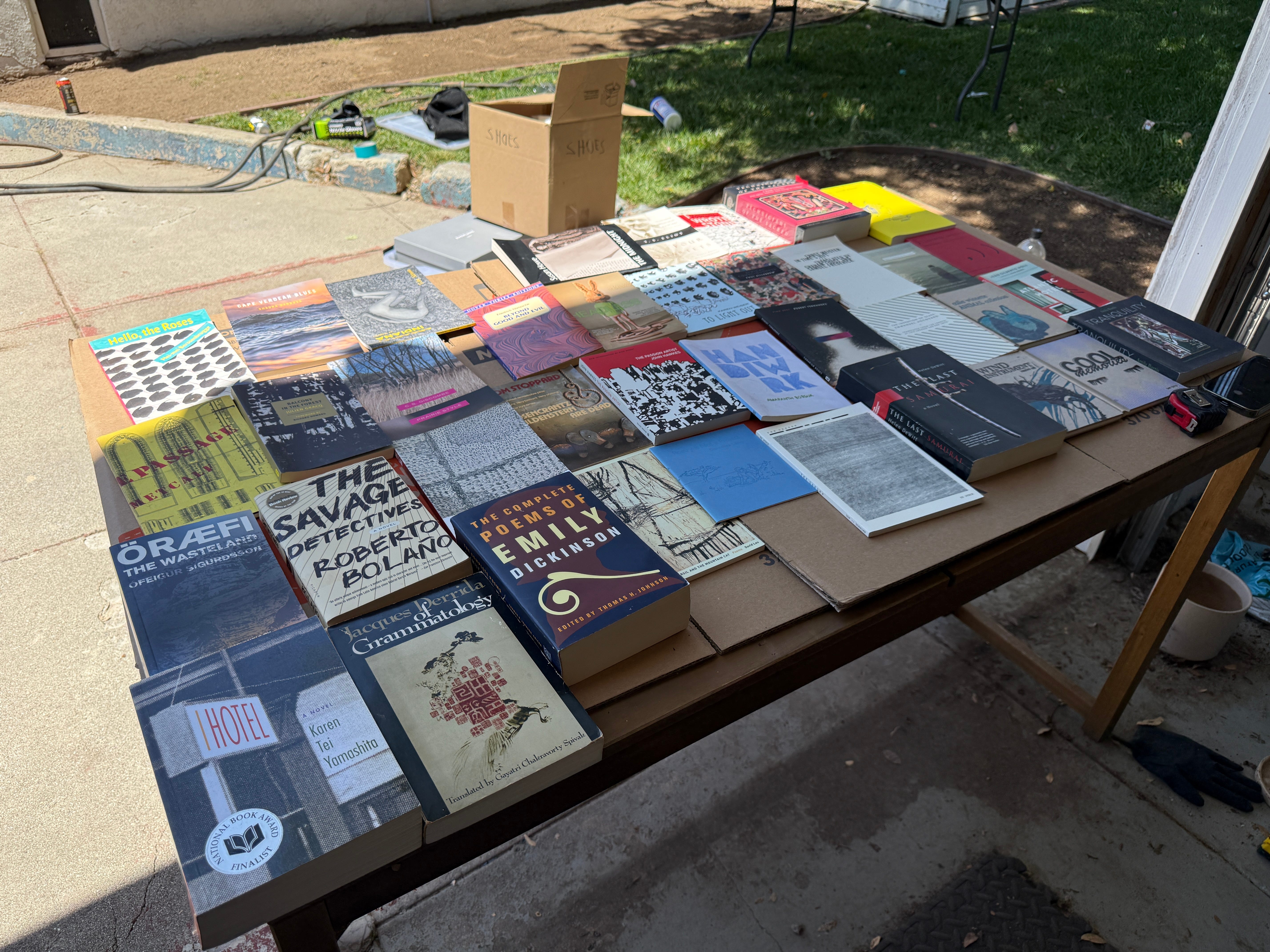
Every book on a folding table
A few weeks before that Istanbul trip, I stood in my driveway in the sun and watched three workers lay out every book I owned onto folding tables. Our home survived the fire. It didn’t burn. But, as we learned, fire can destroy without burning.
My job was to look at each one and approve it for the pile marked unsalvageable. They would photograph it, box it, and take it away. I was able to “salvage” anything truly irreplaceable—a first edition, a signed copy—where “salvage” meant sealing it in a box to off-gas for seven to ten years before it might, maybe, be safe to open again, assuming it isn’t covered in lead like most of our home.
A year earlier, almost to the day, I stood in the same house in protective gear watching scientists take samples to measure how poisonous the fire had made our home. I asked one of them about the books. She told me, more or less: they’re all full of smoke, and it takes seven to ten years for that to leave. As a class, they’re unsalvageable. One book won’t hurt you. New furniture off-gasses too; there are low levels of these compounds around us all the time. One or two on a shelf is fine. But a hundred? A thousand? Two thousand? That’s when you build a toxic environment.
It’s not one book that kills you. It’s a bunch of them.
I’ve thought about that sentence more than I want to admit. The whole premise of a library is accumulation, the slow, decades-long gathering of more, the belief that the next book belongs beside the last one, that the collection is greater than any single volume in it. And accumulation was exactly the thing that had turned my library into something I had to watch be carried away, table by table, book by book, in the sun on my driveway wearing protective gloves and a respirator while some strangers watched and waited for the green light to throw it all away. And further, watching workers strip away our walls and floors and cabinets, watching our house that “survived” get reduced to its skeleton.
What’s left
I salvaged the few books that were genuinely irreplaceable: signed copies of books particularly from my friends, a few first editions that I don’t think I could easily find again, my copy of the first edition of the Norton Anthology of British Literature that I carried across Europe at 23 years old preparing for the GRE Literature exam. I watched the rest, thousands of them, get boxed and taken. Some I’d carried since middle school. Some had traveled with me from Houston to Los Angeles to Boston to Las Vegas to Istanbul and back to Los Angeles, more faithful than most of the plans I’d made for my life.
This week, as I write this, the contents company that inventoried our books and everything else we owned sent me what remains: a PDF of photographs and a spreadsheet documenting the loss for my insurance company. Twenty-five years of building a library, and what’s left is a set of digital traces and whatever I can summon up in my memory.
Who I was, who I am, who I am becoming
I felt grief standing in that driveway, a grief that I still can’t fully wrap my head around. The entire process of watching our home go from “there” to “not there” slowly, incrementally over the course of eighteen months has been a confrontation with the sublime. I can’t comprehend the immensity of what happened to myself, my kids, my family. It’s too big.
And in that immensity, there was more than grief. Hilarity, poignancy, remembrance, honor. But most surprisingly, a sense of freedom, and then guilt about that freedom. In losing everything, we’ve been unshackled from what we had, what we were. New things are more possible because we have to do new things. There’s no other choice.
A library is a self-portrait. It’s the most honest one most of us will ever make (and probably also the most dishonest), and we make it almost without noticing. The books behind you are who you were: what you read, what you meant to be, the obsessions you outgrew and the ones you didn’t. The book on your nightstand is who you are. And the to-read pile, that leaning tower of intention, is who you are becoming, or at least who you keep promising yourself you will become or want to become in some future.
I lost all three at once. And now I have to build it again, or maybe I get to build it again, which means I have to actually ask the question that a library usually answers for you slowly, in the background, over decades: what should be in it? Not what did I happen to accumulate. That library is gone. What belongs now?
That question splits in two. There’s the library for someone like me, a reasonably well-read, thoughtful, forty-ish American with a cosmopolitan streak. The books you’d tell any such person to own to be part of the larger conversation. Everyone should read Gatsby to understand America. That kind of recommendation.
And then there’s the library for someone who is actually me. Not “read Gatsby to be a good American,” but “read Gatsby because you want to know everything about the 1920s.” The books that answer to the specific, slightly embarrassing particulars of a single person’s obsessions.
I want both libraries. I suspect they overlap less than I’d like to believe, and that the gap between them is, more or less, a definition of who I actually am.
Help me rebuild
So here’s the real reason I’m writing again, and the direction this whole project is turning toward: I’m rebuilding a library from zero, and I want your help doing it.
I’ve built a form and I’d love your recommendations. Not just “great books,” though I’ll take those. I mean: given what you can tell about who I am from what I keep circling, what belongs on my shelves? What’s the book you can’t believe I don’t already own? What’s the one you’d press into my hands if we were together in a bookstore?
To make it easier, here’s some of what I have and am gravitating towards: labyrinths, obviously. Istanbul and Constantinople and Byzantium, the whole impossible layered history of that city, and above all the Hagia Sophia, a single building that has been church, mosque, museum, and mosque again, and all the history those stones have witnessed. Memory, history, and time. The philosophy of mind. Vision and how we see, and art, and Holbein, and Berger. Imperialism and its long shadow. Wine, its history and science and cultural importance. My guilty pleasure of crime and noir. Sebald, Borges, Lispector, Bolaño, Woolf, Proust, Pynchon, Baldwin, Kafka, Toomer, Said, Modiano. And the question I never stop asking, the one underneath all the others: what is literature, and why does it do what it does to us?
Because here is what I actually believe, and what makes the rebuilding feel less like grief and more like faith. A book, once printed, becomes a static object and then it moves through time anyway, changing as it goes, even as it stays exactly the same. You open one written a hundred years ago or five hundred years ago and a voice reaches across all those years to tell you something you already knew but didn’t yet know you knew. That’s not nostalgia. It’s closer to time travel, and better than time travel, because it runs both directions: someone, a hundred years from now, might open a book that mattered to me and feel the present I’m living in right now as their present, still true.
A library is how one person holds their small end of that rope that connects to that network—the biggest and baddest of all forms of the labyrinth.
At the very end of The Name of the Rose, the narrator, now aged, returns to the ruined abbey decades after the fire and walks through the ash, gathering what he can: scraps of parchment, a surviving binding, a page with the ghost of a few words still legible on it. Out of the wreckage he assembles what he calls a “lesser library, a symbol of the greater, vanished one: a library made up of fragments, quotations, unfinished sentences, amputated stumps of books.” He is never certain the fragments mean anything. He gathers them anyway.
I have my spreadsheet. My folder of photographs. My one saved book. My scraps. Help me build the lesser library back around them. Help me build my lesser library back around them.
You’ve captured so much about this 18-month benchmark I feel as well. Bravo! It’s writing about the impossible. And how we have to make something possible still.